9. Regarding the follow-through (Zanshin) while maintaining the force applied during the full draw (Kai)
Physical consideration of KYUDO -Japanese archery
9. Regarding the follow-through (残身/Zanshin) while maintaining the force applied during the full draw (会/Kai)
This is something that someone as inexperienced as me cannot explain.
I will simply include the report that the professor left behind.
January 15, 1981
Regarding the follow-through (残身/Zanshin) while maintaining the force applied during the full draw (会/Kai)
(1) About the bow drawn with a hand grip.
Today, some people even believe that you can shoot a bow with just two hands. In other words, they think that if you somehow manage to string the bow, pull it back, balance it with both hands, and then release it gently and skillfully with your fingertips, you'll hit the target.
In other words, by paying attention to "balance" and "timing," I'm devising a way to "release" the bow in a way that minimizes "shock." This means that "the draw is the draw," "the release is the release," and "the follow-through is the follow-through" are all completely different things. In particular, it's an "active release," not a "natural release."
To put it more bluntly, a full draw (会/Kai) is the same as a half draw (大三/Daisan), and it's just that you're supposed to make that shape, so you have no choice but to assume that posture to get the job done. The same goes for the follow-through (残身/Zanshin"). Especially when you're being strictly corrected on your follow-through (zanshin) during examinations, you'll just make up the posture for a few seconds as a condition for promotion.
Therefore, the Japanese greatbow, which is "the most difficult to draw and hit the target with in the world," is a truly inefficient tool, and we must recognize the unique shooting techniques, training, and aesthetic skills of the Japanese greatbow, given its highly irrational design. Furthermore, we must investigate the significance of the unique tradition of the Japanese greatbow and its relevance in the present day.
(2) What is a "natural release"?
"Release" should be viewed as a natural phenomenon. "It comes apart naturally" is the correct expression. Therefore, it's not a technique where you consciously cut it off, or release it by skillfully balancing the left and right sides and timing it with a quick flick of your fingertips.
As long as you are "actively releasing," it will never be a "natural release." It is "artificial" and "man-made," so it is neither "natural" nor "inevitable." As long as you are consciously doing it yourself, "releasing" will never be a "natural release."
It's important to realize that "natural separation" only occurs when you "set up a situation that encourages separation," as that's the limit of human intervention and artificial means.
In terms of "effort," it means continuing to "put your whole body into it" until it "naturally becomes detached" from it.
(3) The reason for saying "the follow-through (Zanshin) while maintaining the force applied during the full draw (Kai)"
This is a simplified representation of the concept. The true meaning of "natural release" must be grasped by the fact that it is not explicitly mentioned. Certainly, the phenomenon of "natural release" exists. To put it simply, it is a "natural phenomenon." Therefore, it means "releasing naturally as it is meant to."
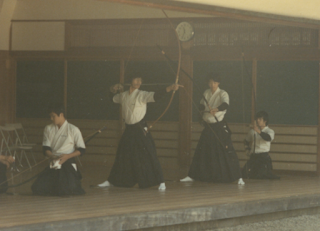
Note: A photograph of "a 1 in 20,000 moment" is attached separately. Pursuing this level of understanding makes one a true connoisseur.
It happens like a balloon bursting as you maintain tension during a full draw. It's not something you "actively release." Therefore, it "happens naturally as an extension of the full draw," which is precisely what constitutes a "natural follow-through," or "the subsequent expansion" (in the old style).
Therefore, "the effort of a full draw" is the limit of human potential, and all that can be done. Thus, it boils down to a single-minded focus on "maintaining tension, maintaining tension," and nothing else.
If a "natural release" is a natural phenomenon, then a "follow-through" is also a natural phenomenon. The old "seven steps" did not include a section called "follow-through." It was included within the "release" and called "expansion after the release." It always appears after a "magnificent release." This "expansion after the release" was highly praised. This was the "highlight of Japanese archery," a truly "beautiful form" that was completely natural.
This is not something you can create or achieve by trying. However, anyone can reach that magnificent "expansion after the release," or "lingering posture," that is sure to be highly praised. The path to achieving this is "the correct way of Japanese archery."
When you ask yourself "when does that kind of shot actually happen?", it's when you enter a "full draw" and your mind and spirit gradually fill up, your whole body expands like a "snowman" so much that you think, "Wow, wow, wow," and then your whole body becomes completely numb, and you even wonder what's going to happen to you. Then, in an instant, an explosion occurs. And only after the arrow has flown out do you realize, "I didn't even realize the arrow had flown out," or "It had left my body."
The follow-through state, like the "expansion after release," is the rebound after the explosive release from the full draw. The tension that had been building up suddenly disappears in an instant because the pressure from the bow, the opponent, is gone, causing the whole body to reflexively open up and be released. However, the state of mind and spirit remains focused on maintaining tension and tension. This mental energy is the "expansion after release," and the "follow-through state" that naturally emerges.
Therefore, this is not something that can be created by trying, nor is it something that can be achieved by trying. The body does not fly away with the arrow, so the body certainly remains (a lingering presence), but the explosion and the realization that it has exploded only occur after the arrow has flown away. Therefore, the honest state of mind is a wonderful state of "nothing remaining in the mind," a refreshing and exhilarating feeling.
Therefore, anything that flashes in your mind at the moment of release is fake, and anyone who feels "Oh no, I should have done that" at that moment of release is using a fake bow. No matter how many decades you spend using such a worthless bow, it's still a scam, deceiving yourself and others, which is why I criticize it as "rotten character" or "low-class bow."
That's all.


Next time, we'll be discussing "Thinking about the secret grip at the (full draw/Kai)". We look forward to your next visit as you become more familiar with "hitting the target (的中/Tekichu)".



コメント
コメントを投稿